Every April, Historic Downtown Galveston fills up with binoculars, name tags, and out-of-town birders chasing warblers through the streets during FeatherFest. It's the event people know. It's also, for anyone who actually lives on the West End, the wrong season to pay attention to.
The real spectacle started two weeks ago, and it doesn't need a festival, a parking pass, or a guide. It's happening on Stewart Road, the two-lane stretch locals have nicknamed Hawk Alley, and you can watch it from your car on the way to buy groceries.
What's Actually Different About Fall
Spring migration in Galveston is a songbird show. Warblers, orioles, tanagers moving north in waves of color, best seen on foot in the shade of a nature preserve. Fall is a different animal, literally. As birds head south along the coast, raptors funnel down the barrier island because they avoid long open-water crossings, and Stewart Road's open prairie and utility poles give them exactly what they need: elevated perches with a clear view of prey below.
That's why fall and winter turn this one road into a working flyway. Watch the highlines and poles along Stewart Road for migrating Swainson's Hawks, returning Ospreys, American Kestrels, and Belted Kingfishers, alongside overwintering Red-tailed Hawks and the island's year-round specialties, White-tailed Kite and Northern Crested Caracara. None of that requires FeatherFest's April calendar. It requires driving the same road you already drive.
The scale behind it isn't small, either. Roughly one in four birds migrating through the entire United States in fall passes through Texas, according to the Lights Out Texas campaign, and the BirdCast migration dashboard tracks Galveston County's nightly totals from August 1 through November 15 every year. That window opened about a month ago and still has more than two months left to run.
The Two-Stop Detour That's Already Part of Your Route
If Stewart Road is the drive-by version, the ten-minute stop is Lafitte's Cove Nature Preserve, tucked off Stewart Road via Eckert Drive. It's free, open year-round, and small enough that a walk through it fits between errands rather than replacing your whole Saturday. The preserve sits on the Texas Coastal Birding Trail and exists today largely because of one local conservationist, Eva Egert, who worked to protect the land before it became the boardwalk-and-pond preserve residents walk now.
About a tenth of a mile further west sits Lafitte's Grove, a smaller stop most people drive past without noticing the historical marker. The oaks here took real damage in Hurricane Ike. What's left still pulls in migrant landbirds every fall, which says something about how little a stand of live oaks needs to keep doing its job once it's standing at all.
Further down the island, near Sea Isle off Seabird Drive, Dos Vacas Muertas Bird Sanctuary covers six bayside acres with a pond, a small marsh, and a live oak motte. It's not on most visitors' radar because it was never built for visitors. It's a working stopover, and West End residents are the only people who pass it regularly enough to notice when the pond fills back up after a dry summer.
None of these three stops require a ticket, a guide, or a festival weekend. They require knowing they're there, which is exactly the kind of knowledge that doesn't show up on a tourism calendar.
If you only have twenty minutes, skip the preserves entirely and just drive Stewart Road slowly at golden hour with your windows down. The poles do most of the work.
The Porch Light You Turn Off Traces Back to Your Own Town
Here's the part almost nobody connects to where they live. Lights Out Texas, the statewide campaign asking residents and businesses to turn off non-essential lighting at night during migration season, didn't start in Austin or Dallas. It started in Galveston, in 2017, after roughly 400 birds died in a single night colliding with the American National Insurance Company's building, an event that pushed Houston Audubon and American National into launching the original lights-out effort before it ever went statewide, according to Texan by Nature.
That means when a West End resident flips off the porch light or closes the blinds after 11 p.m. this September, they're not just following a generic conservation ask. They're participating in something that began right here on the island, not in some distant capital pushing a mandate down.
The practical version is simple. Turn off non-essential outdoor and landscape lighting between 11 p.m. and 6 a.m. from mid-August through the end of November, with the heaviest impact during September and October, when nighttime migration traffic peaks. If a light has to stay on for safety, keep it shielded and pointed down rather than up into open sky. None of this requires new equipment. It requires remembering to do it during the two months it matters most.
The State Already Confirmed What the Island Knew
In January 2025, Texas Parks and Wildlife and Audubon Texas named Galveston the first Bird City Texas "High-Flyer" community in the state, a distinction built on completing 37 separate conservation actions, ten more than the 27 required for the designation, according to the American Bird Conservancy. Galveston had already held the base Bird City Texas designation since January 2021. The High-Flyer upgrade recognized four years of habitat restoration, window-collision prevention work, and public education that built on top of that original certification.
What actually earned it wasn't a single ribbon-cutting. It was the accumulation of ordinary choices, the coastal marsh and dune restoration work, residents keeping cats indoors, native plants going into yards instead of ornamentals, window treatments that cut down on bird strikes. Those are neighborhood-level habits, not agency projects, and the state's own evaluation treated them that way when it made Galveston the first city in Texas to clear the High-Flyer bar.
Why This Matters More Than the Calendar Suggests
The easy story is that Galveston's birding season peaks in spring, because that's when the festival happens and the marketing gets loudest. The story that actually holds up if you live here full time is closer to the opposite. Spring belongs to visitors with a weekend to spend and a guide booked in advance. Fall belongs to whoever already drives Stewart Road on a normal Tuesday and happens to look up at the right pole at the right hour.
That's not a small distinction if you've lived on the West End for years and never quite registered why the utility lines along Stewart Road seem busier in October than in June. It's not decoration. It's the same coastal geography that funnels raptors down this stretch of barrier island every single fall, the same reason San Luis Pass further down the road rivals Bolivar Flats for sheer waterbird volume in winter.
The migration window runs through November. The lights-out window runs alongside it. Neither one needs an event page or an RSVP. They just need someone paying attention to a road they already know by heart.
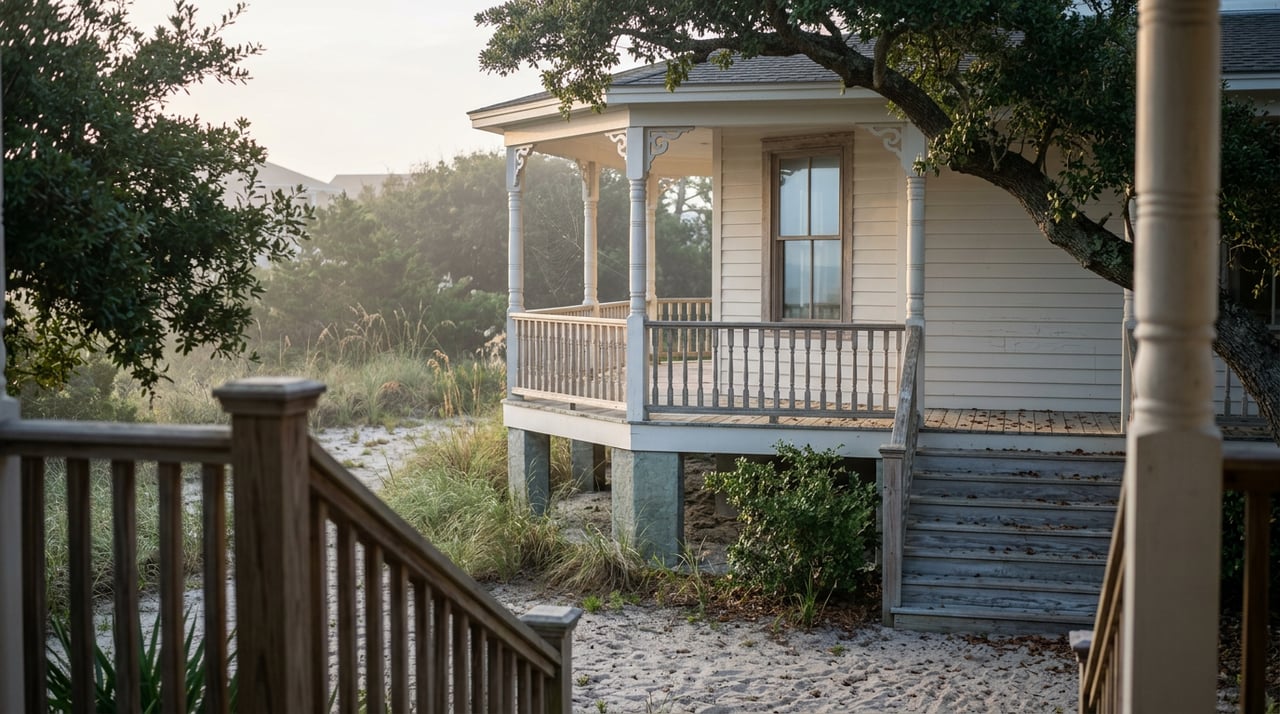
That kind of local rhythm, the stuff that never makes it into a visitor brochure, is exactly what shapes daily life on the West End beyond any listing photo. Spagnola Realty Group works this stretch of coastline because we live inside these same seasons, not because we found them on a map. If a West End property, a canal-front lot, or a second home near this corridor is ever part of your own plans, we'd welcome the conversation. Get exclusive access to top listings, schedule a consultation, and let's talk about what living here actually looks like, season by season.